
What is a unified AI API gateway?
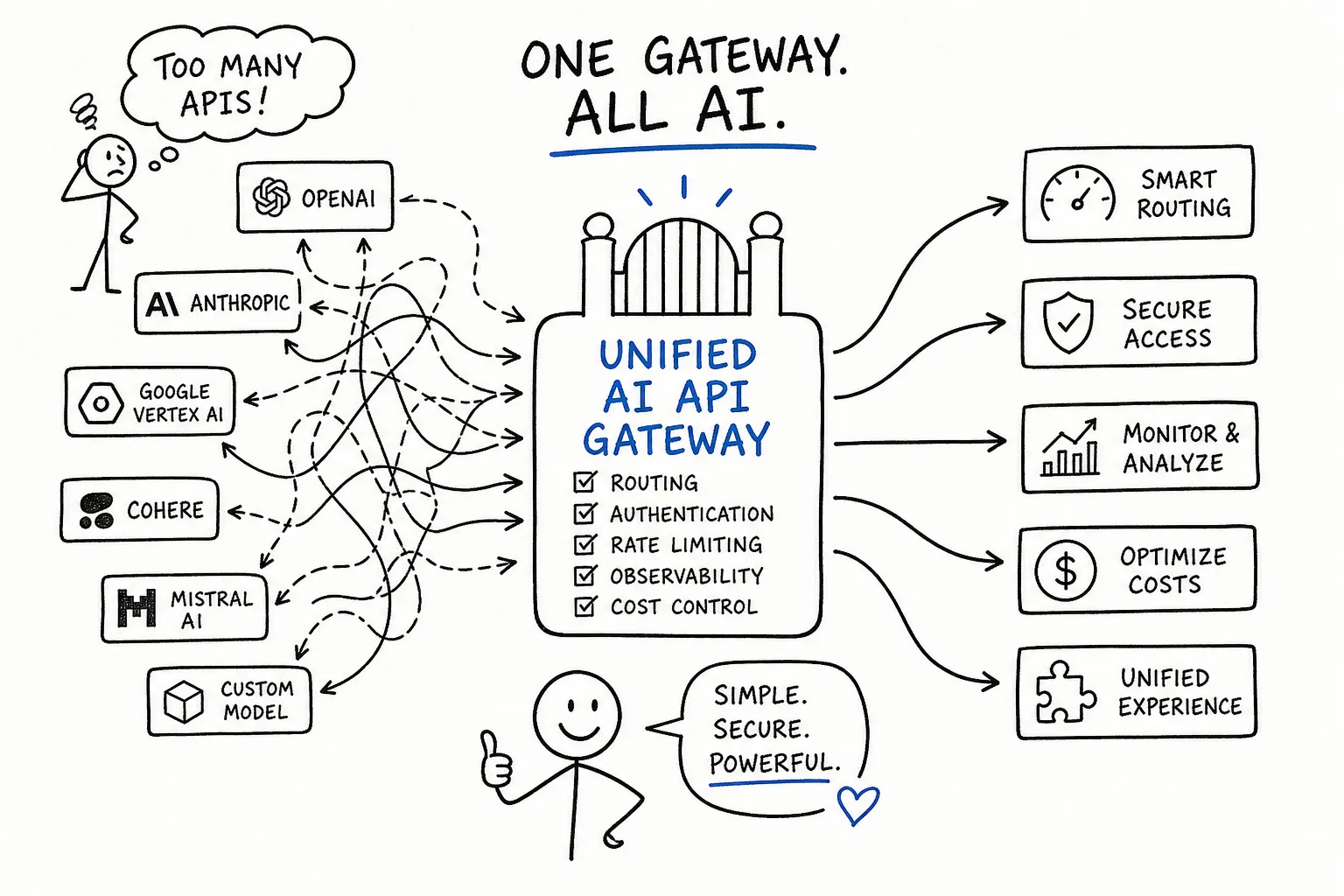
A unified AI API gateway is middleware that sits between your application and every AI model provider. You call one endpoint with one key, and the gateway handles authentication, routing, failover, safety checks and cost attribution on the way through. Your app never needs to know whether OpenAI, Anthropic or Google answered the request.
That is the whole idea. The rest of this article is what that buys you, how a request actually moves through such a system, and how to tell a production-grade gateway from a thin proxy.
We run one, so the examples are from ours. The concepts apply whether you end up on a managed vendor or a self-hosted open-source project.
Why teams reach for one
Most teams building with AI are managing several provider accounts at once. Separate API keys, separate billing dashboards, and provider-specific SDKs glued together with code nobody wants to own. Every new model is another integration to maintain, another invoice to reconcile, and another failure point with no graceful path.
This is not only a scaling problem. A solo developer with two active providers already feels it. Your OpenAI key lives in one environment variable, your Anthropic key in another, and the Google key sits somewhere a teammate set up six months ago. The SDK maintenance burden grows with every provider you add, and tracking separate billing contexts makes real cost visibility close to impossible.
What happens when a provider goes down
With direct integrations the failure mode is brutal and simple: your AI feature breaks. One provider is hardcoded, there is no fallback, so a single outage becomes a user-facing incident. A production app calling a provider at 2am and receiving 503s with no automatic reroute passes that failure straight to users.
A gateway that holds a failover chain changes this. When the primary provider returns a 503 or a rate-limit 429, the gateway classifies the error as retryable, sends the same request to the next provider in the chain, and returns the response to your application. The app sees success. What would have paged your on-call engineer becomes a logged routing event.
How a request moves through the gateway
The lifecycle is where the value gets concrete. For a typical inference request:
- Your app sends a request to the gateway's single endpoint using your gateway API key.
- The gateway authenticates the request and validates the token, scope and tenant context.
- Policy and safety checks run: PII detection, prompt-injection screening, model allowlist verification.
- Routing logic selects the target provider based on availability, cost, latency or configured policy.
- The gateway transforms the request into that provider's expected format and forwards it.
- The provider responds, and the gateway normalizes the response into a standard schema.
- Output validation and post-processing checks run before delivery.
- The gateway logs token usage, latency, cost and policy decisions, then returns the response.
Step six is what makes the architecture durable. Because your app always receives the same response structure, you can swap the underlying model without touching application code. A team moving from GPT-5.5 to Claude Opus 5 changes a routing config rather than refactoring an integration.
What a production gateway actually does
Intelligent routing and automatic failover
Real routing is more than "try one provider, then another". The policies that matter are static primary-plus-fallback chains for baseline reliability, weighted load balancing for traffic splitting, latency-based adaptive routing for user-facing work where response time is visible, and cost-aware routing that pushes simpler tasks to cheaper models.
The non-negotiable part is that failover requires zero code changes from the application layer. If your app has to implement retry logic, provider detection or fallback handling, the gateway has not done its job.
There is a second-order effect worth knowing about. Once a gateway routes the same model across more than one upstream rail, the rails do not perform identically. We publish measured success rate and latency per model from real traffic through our own gateway, refreshed continuously, precisely because vendor-claimed uptime and observed behavior are different numbers.
Security and guardrails at the edge
A production gateway enforces policy before any request reaches a model. PII detection and prompt-injection screening run as pre-flight checks inside the gateway process, with no extra network hop. Model allowlists and blocklists restrict which models a given key or team can reach. Per-key rate limits stop a runaway agent from burning through your balance.
The principle underneath is gateway-side credential injection. Your application authenticates with its own key. The gateway attaches the upstream provider credentials on the way out. Provider keys never appear in application code, environment configs or logs. Centralized audit logging records every model request, policy decision and credential use, which is the baseline for any team with compliance obligations.
Cost visibility that survives contact with finance
Chasing AI spend across five provider dashboards with different pricing models and billing cycles is not a workflow. A proper gateway meters every request at the token level and attributes cost to the project, team or client that generated it. Per-team spend caps and budget alerts let you enforce limits before an overrun instead of explaining one afterwards.
One distinction is worth flagging. Some gateways use invented credit systems that put a conversion layer between what you spend and what you actually owe, which makes forecasting harder than it needs to be. Real-dollar pricing means the cost returned on the response is the actual USD amount. On ApexApi that number arrives in the X-ApexApi-Cost response header on every call, to eight decimal places, including streaming responses. The figure in your logs is the figure on your invoice.
Breadth, and what it is worth
Model count is the metric every gateway leads with, and it is the least useful one on its own. What matters is whether the catalog holds the models you need across the modalities you need them in.
Our catalog serves 130+ models spanning text, image, video and audio, all on one key and one balance. Some gateways list several times that number. Whether a larger list helps you depends entirely on whether the extra entries are models you would actually ship against.
Managed versus open-source
Several projects address parts of the unified API problem. For production workloads the criteria that separate them are model breadth, failover behavior, built-in guardrails, web context tooling, pricing model and deployment shape.
| Gateway | Models | Auto failover | Built-in guardrails | Web context tools | Pricing | Deployment |
|---|---|---|---|---|---|---|
| ApexApi | 130+ | Yes | Yes (PII, prompt-injection, allowlists) | Yes (scrape, crawl, extract) | Real USD, no subscription | Managed |
| OpenRouter | 300+ | Yes | Limited | No | Credits | Managed |
| LiteLLM | 100+ providers | Yes (config) | Plugin-based | No | Self-hosted | Open-source |
| Portkey | 250+ | Yes | Yes | No | Subscription tiers | Managed and self-hosted |
| Helicone | Observability-first | Partial | Partial | No | Free tier plus paid | Managed and self-hosted |
Counts reflect vendor documentation as of August 2026 and move often. OpenRouter's catalog is materially larger than ours; if raw breadth is your only criterion, that is the honest answer.
When self-hosting makes sense
Open-source gateways like LiteLLM give you self-hosting, data-plane ownership and no vendor dependency. That trade is worth making when you have dedicated platform engineering capacity and infrastructure to absorb the operational load. You own the upgrade cycle, the scaling decisions, the monitoring and the security hardening.
For many product teams the arithmetic is worse than it looks. Without dedicated DevOps capacity, the build-and-maintain cost of a self-hosted gateway tends to exceed a managed service sooner than expected. Managed gateways trade some control for operational simplicity: nothing to run, no upgrade cycles, and new models appear as providers release them. If your team's job is building the application rather than operating the AI infrastructure layer, managed is worth serious consideration.
Five questions that narrow the field fast
- How many models and modalities do you need today versus in six months? A narrow catalog forces a migration the moment your requirements expand.
- Do you need agent-native features? For agentic workflows, MCP server support and programmatic API key provisioning are requirements, not extras.
- What are your compliance and data-handling constraints? PII handling, audit logs and regional routing narrow the field sharply for regulated workloads.
- Do you have capacity to operate a self-hosted gateway? Be honest here. Platform engineering time is rarely as available as roadmaps assume.
- Does the gateway price in real dollars? Credit abstraction adds reconciliation overhead and reduces forecast accuracy.
Making the switch without rewriting anything
Most production-ready gateways, ApexApi included, expose an OpenAI-compatible API. For most teams migration is a one-line change: swap the base URL and the key, and existing SDK calls route through the gateway. No new SDK, no request format to rewrite, no provider-specific branching to untangle. Provider-specific optional fields may still need a look, but the core request path is compatible by design.
Three things are worth validating after you switch. Confirm failover behavior by sending traffic while a provider is degraded and checking that no errors reach your application. Check cost reporting against a known workload so the metering matches what you expect. Review guardrail configuration, verifying that PII detection is active on any route handling user-generated content and that model allowlists are scoped correctly per team or key.
The right architecture from the first integration
A unified AI API gateway is not an optimization you bolt on at scale. For most teams it is the right shape from the first time you integrate a second provider, because the problems it solves show up immediately and compound with every provider after that. Reliability gaps, security enforcement and cost visibility do not wait for a traffic threshold.
Consider what each capability changes in practice. When failover lives in the gateway, an outage stops being an incident and becomes a log entry. When guardrails are enforced centrally, you stop relying on application code to get security right on every route. When metering is in real dollars and attributed by team, AI spend becomes something you manage rather than reconcile.
ApexApi gives you 130+ models across text, image, video and audio, failover across provider rails, web context tools for scraping and structured extraction, and USD pricing on every response, all on one key. If you already use the OpenAI SDK, the first request through it is a base URL change. Read the quickstart or get a key and test the failover behavior yourself.
Frequently asked questions
- What is a unified AI API gateway?
- It is middleware that sits between your app and every AI provider. You call one endpoint with one key, and the gateway handles authentication, routing, failover, safety checks and cost metering. Your app never needs to know which provider answered.
- What is the difference between a unified AI API gateway and a standard API gateway?
- A standard API gateway manages HTTP traffic, rate limiting and authentication for general web services. An AI gateway adds AI-specific primitives on top: token-level cost metering, model routing and failover, prompt safety checks, and response normalization across providers that all return different shapes.
- How does a unified AI API gateway handle model failover?
- It watches the provider response. When a configured provider returns a retryable error such as a 503 or a 429, the gateway sends the same request to the next provider in the fallback chain and returns a normal successful response to your app. Your code never sees the failure.
- Do I need to rewrite my code to use one?
- Usually not. Most gateways, including ApexApi, expose an OpenAI-compatible format, so migration is a base URL and API key change. Provider-specific optional fields may still need review, but the core request path is compatible by design.
- Is a unified AI API gateway worth it for a small team?
- Often yes. Credential sprawl, split billing and missing guardrails create friction from the moment you add a second provider, not at some later scale threshold. A managed gateway removes that overhead without needing platform engineering capacity to maintain it.
- How much does it cost to run through a gateway?
- It depends on the gateway. Some resell inference on a credit system, which adds a conversion layer between what you spend and what you owe. ApexApi returns the actual USD cost of every call in the X-ApexApi-Cost response header, to eight decimal places, so the number in your logs is the number you are billed.
Recommended
More posts
- How an AI agent funds and pays for its own API calls
Registration, balance and top-up as three HTTP calls instead of three web forms. The flow, the caps that keep it safe, and when a human is still required.
- Scrape, crawl and extract on the same key as your models
Three web context endpoints on the balance that already pays for inference. What each one costs, when to reach for which, and what you stop maintaining.
- Structured output across providers, and where it fails
JSON mode is three different guarantees wearing one name. What ports between providers, what gets silently ignored, and why you validate anyway.
One API key for every AI model
Start free