
Claude Opus 5 is live on ApexApi: Anthropic's best coding model, same price as Opus 4.8
Anthropic released Claude Opus 5 on July 24, and it's already live in the ApexApi catalog as anthropic/claude-opus-5. Same key you already have, one string to change.
The short version of why you should care: this is the model most people should now be pointing their coding agents at. Anthropic's positioning is unusually direct. Near-flagship intelligence at half of Fable 5's price, and the early numbers back it up.
What's actually new
Opus releases have historically been "a bit better at everything." This one is more pointed. Three things stand out from the announcement and the model card:
Coding is the headline. Opus 5 is built for long-horizon work in real codebases: multi-file features, big refactors, architecture-to-deployment runs. On CursorBench 3.2 it lands within half a percent of Fable 5 at half the cost, and Cursor's co-founder is quoted saying exactly what the chart shows: near-Fable intelligence at Opus speed and price.
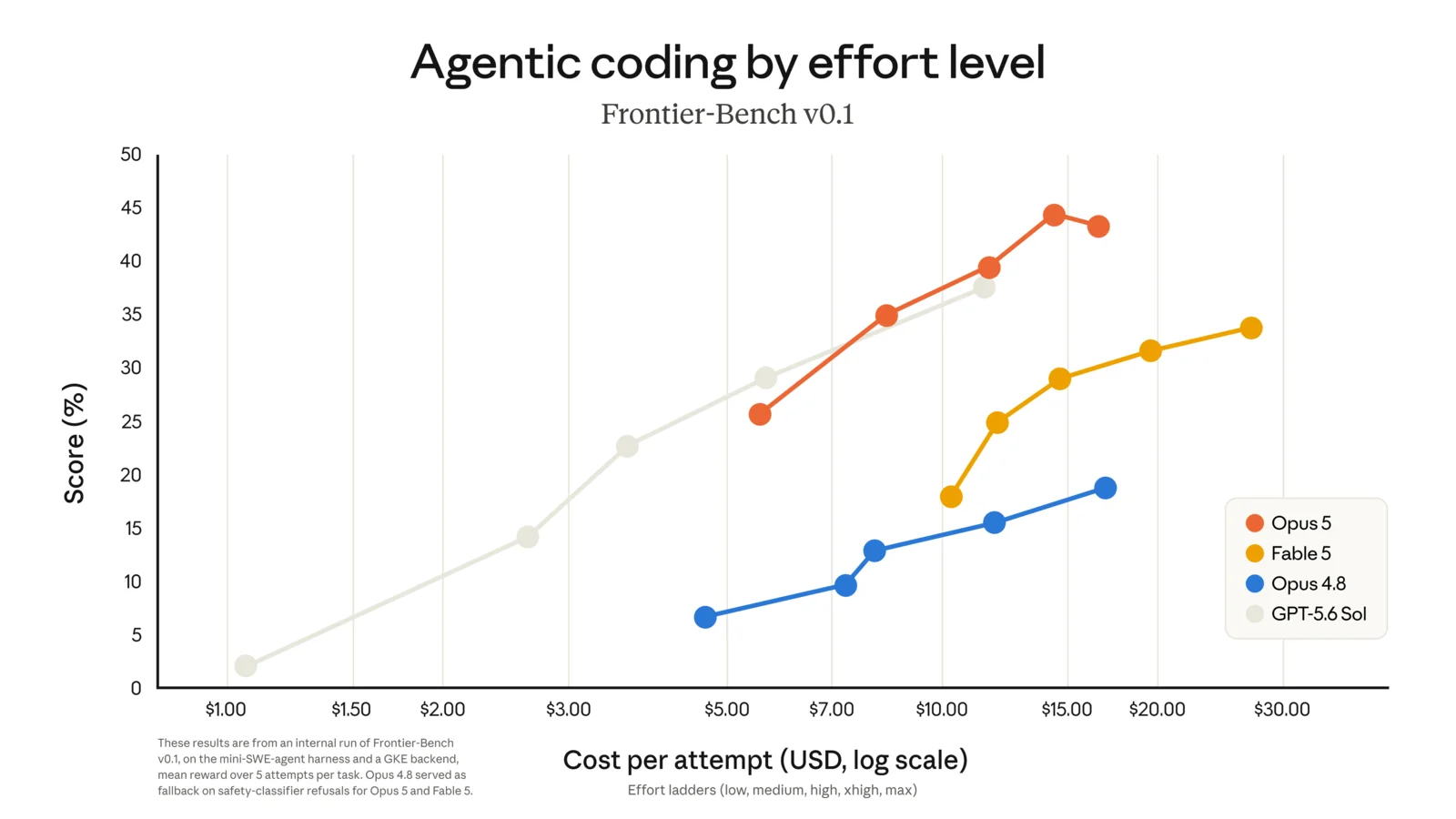
Agents that stay on track. The model plans before it acts, coordinates subagents and parallel tool calls, and, per Anthropic, verifies its own work without being told to. On Frontier-Bench it roughly doubles Opus 4.8's score at lower cost:
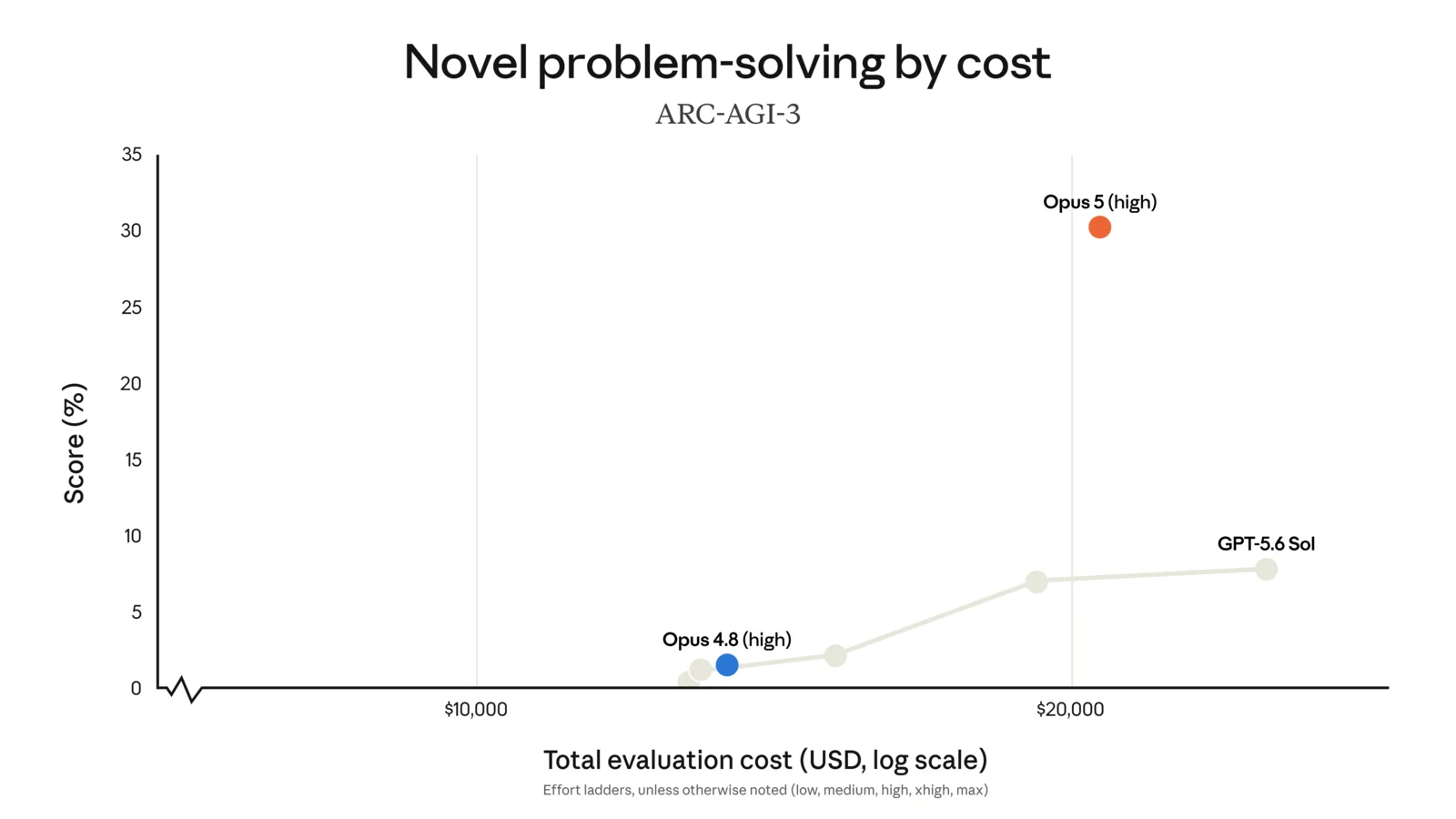
Novel problem-solving took a real jump. ARC-AGI 3 measures reasoning on problems the model has never seen. Opus 5 scores roughly three times the next-best model. That's the kind of delta you rarely see between adjacent releases:
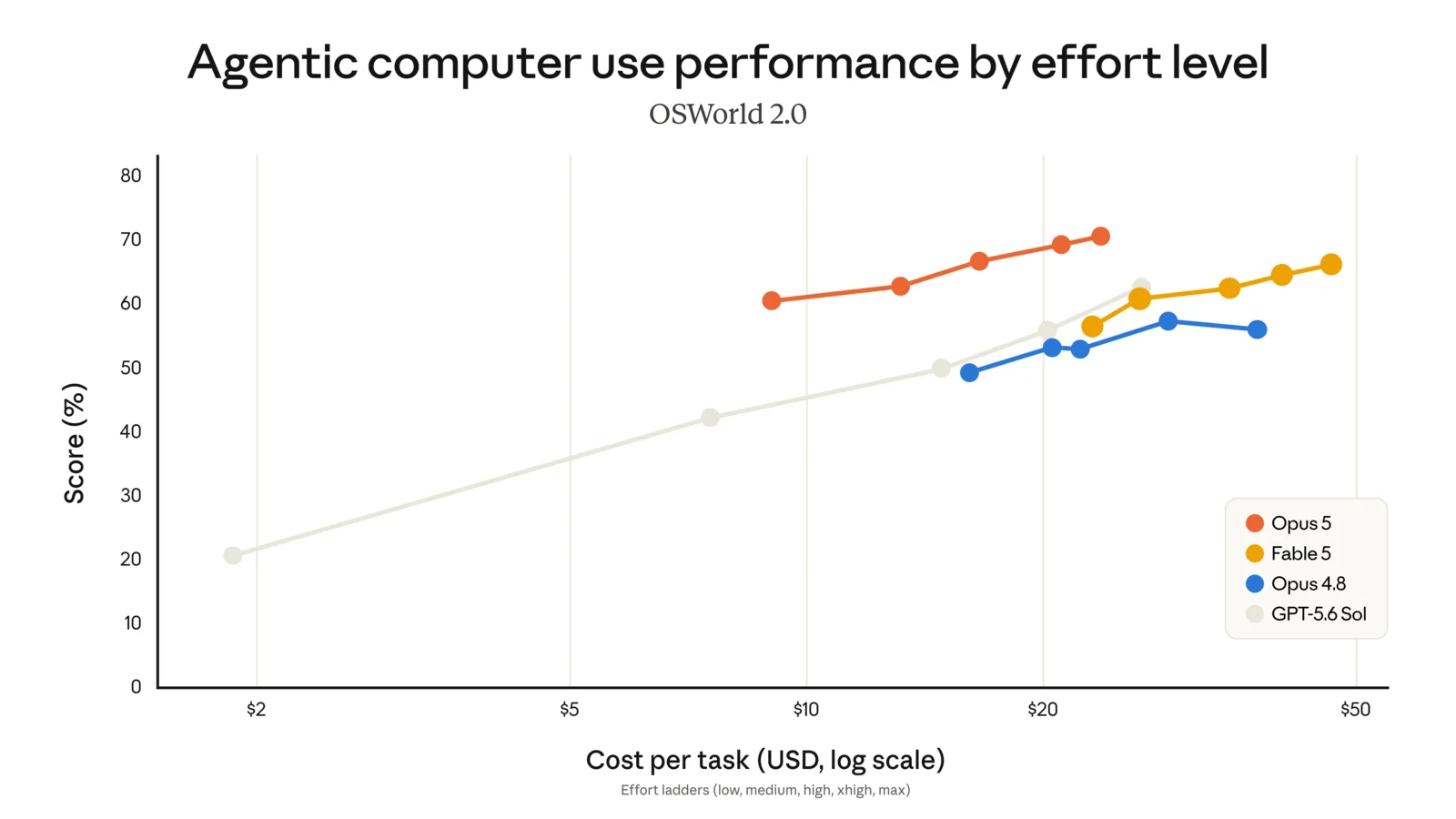
It's also the strongest Opus yet at vision and computer use: dense documents, charts, screenshots, and multi-app desktop tasks.
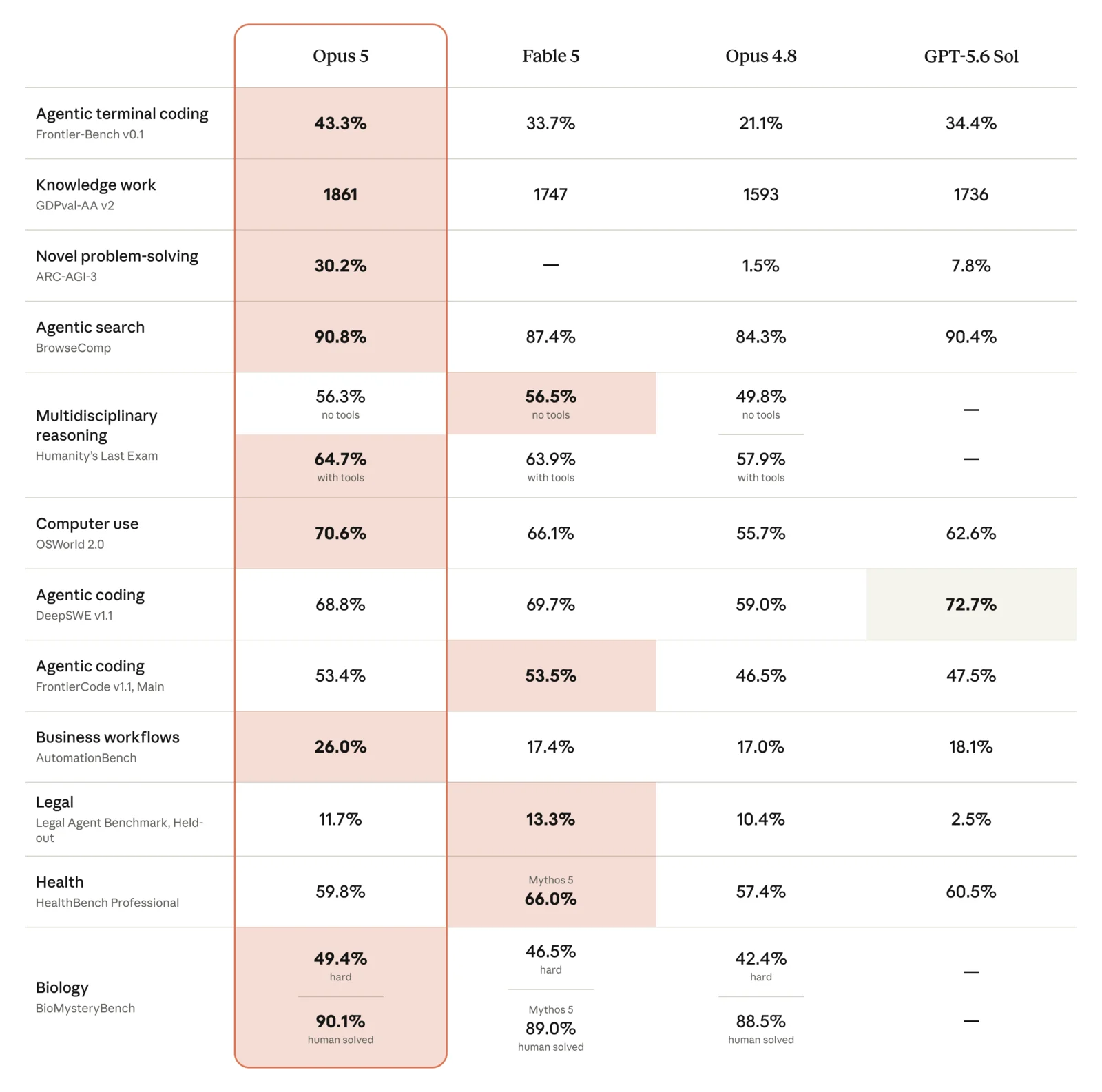
Benchmarks are Anthropic's own numbers, so read the full announcement for methodology. But the pattern across independent quotes (Cursor, JetBrains) matches what you'd expect from the pricing move: this is meant to be the workhorse.
The price didn't move
This is the part we like most. Opus 5 costs exactly what Opus 4.8 costs:
- $6.00 / million input tokens
- $30.00 / million output tokens
All-in on ApexApi, service fee included, pay-per-use. If you're on Opus 4.8 today, the upgrade is free. You just change the model string. For comparison, Claude Fable 5 is $12/$60 through us, so Opus 5 at near-Fable coding performance is the obvious default for most agent workloads.
Live specs and pricing are always on the model page, pulled straight from the same table that bills you.
Switching takes one string
If you already call ApexApi, this is the whole migration:
curl https://api.apexapi.dev/v1/chat/completions \
  -H "Authorization: Bearer ak-your-key" \
  -H "Content-Type: application/json" \
  -d '{
    "model": "anthropic/claude-opus-5",
    "messages": [{"role": "user", "content": "Refactor this module to use async/await."}],
    "stream": true
  }'
Works the same from the OpenAI SDK, Cursor, n8n, LangChain, or the ApexApi MCP server. Anywhere you can set a base URL and a model name.
Two quirks we already handled for you
New Anthropic reasoning models come with API changes that break naive integrations. Two matter here:
- Opus 5 rejects
temperatureandtop_p. Most OpenAI-compatible clients send them by default, and the raw Anthropic API answers with an error. ApexApi strips sampling params for models that don't accept them, so your existing n8n workflows and SDK code keep working unchanged. - Thinking is on by default. Opus 5 reasons before answering whether you ask it to or not, and that reasoning counts toward output tokens. Budget
max_tokensa bit more generously than you did on non-thinking models. The payoff is the quality jump in the charts above.
We also serve the model on more than one delivery rail with automatic failover, so a provider-side incident doesn't take your app down. You never see the rail; you just see anthropic/claude-opus-5.
Try it
- Model page: apexapi.dev/models/anthropic/claude-opus-5
- Full catalog: apexapi.dev/models with 139 models behind one key
- New here? Create a key, buy credits, pay only for what you call.
We smoke-tested it live through the gateway the day it landed in the catalog. It's good. Point your hardest coding task at it and see.
Frequently asked questions
- How do I use Claude Opus 5 on ApexApi?
- Point any OpenAI-compatible client at https://api.apexapi.dev/v1 with your ak- key and set the model to anthropic/claude-opus-5. If you're already calling another model through ApexApi, the upgrade is changing that one string.
- How much does Claude Opus 5 cost on ApexApi?
- $6.00 per million input tokens and $30.00 per million output tokens, all-in. That's the same as Claude Opus 4.8, so upgrading costs nothing extra. Pay-per-use credits, no subscription.
- Should I use Opus 5 or Claude Fable 5?
- Opus 5 is the default pick for coding and agents: Anthropic's own benchmarks put it near Fable 5 on real-world coding at half the price. Fable 5 ($12/$60 on ApexApi) still has the edge on the very hardest reasoning and longest-horizon work. Both are one model-string apart, so A/B them on your own workload.
- Will it work in Cursor, n8n, or my existing OpenAI SDK setup?
- Yes. Opus 5 rejects temperature and top_p at the provider level, and most OpenAI-compatible tools send them by default. ApexApi strips them for you, so existing integrations keep working without touching client settings.
Recommended
More posts
- How to use Claude with the OpenAI SDK, and what breaks
Keep the OpenAI client, change three values, call Claude. What survives the translation, what has no equivalent, and when to use the native SDK instead.
- Images and Videos are live: Veo, Kling, Seedance, Nano Banana and more — one key, real prices
ApexApi now ships full image and video generation: 29 image models and 26 video models behind one API key, with a visual studio in the dashboard, reference images, first/last frames, and the exact USD price shown before you generate.
One API key for every AI model
Start free